
7 Best Provider Operations Platforms for Healthcare Organizations in 2026
2026 Guide

Hiring a provider is only the beginning.
Before that provider can reliably see patients and generate revenue, healthcare organizations may need to manage licensing, credentialing, payer enrollment, effective dates, payer IDs, roster updates, recredentialing, and ongoing monitoring.
For a small provider group, some of that work can be managed manually. But as organizations add providers, locations, states, payers, and tax entities, provider operations quickly become difficult to coordinate across spreadsheets, portals, inboxes, and disconnected systems.
Provider operations platforms are designed to bring more of that work into one place and increasingly automate the workflows behind it.
What is a provider operations platform?
A provider operations platform helps healthcare organizations get providers active, in-network, compliant, and ready to bill, then keep them that way as provider and payer information changes.
Depending on the platform, that can include:
● Provider credentialing
● Primary source verification
● Payer enrollment
● Licensing
● Roster management
● Provider data management
● CAQH management
● Recredentialing
● Sanction and exclusion monitoring
● License and credential monitoring
● Provider onboarding and privileging
The biggest difference between platforms is not simply the number of features they list.
Some systems primarily store provider data, organize workflows, and help teams track tasks and status.
Others go further by using automation or AI agents to perform parts of the underlying credentialing, enrollment, licensing, roster, and monitoring workflows.
That distinction becomes increasingly important as provider volume grows.
The best provider operations platforms in 2026
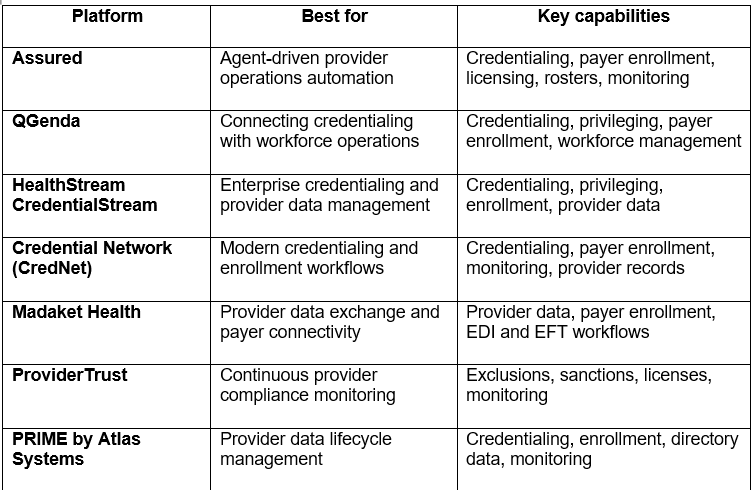
1. Assured
Best for: Healthcare organizations that want AI agents to automate provider operations across credentialing, payer enrollment, licensing, rosters, and monitoring
Assured is an AI-powered provider operations platform where software agents run credentialing, payer enrollment, licensing, roster management, and ongoing monitoring from a shared provider record.
Instead of giving teams another system for tracking tasks, Assured's agents perform the underlying operational workflows across primary sources, CAQH, payer applications, authenticated payer portals, rosters, and provider records.
The agents can continue workflows over time, determine what needs to happen next, complete routine steps, and bring the appropriate team member in when a decision or exception requires human input.
That model is particularly useful because provider operations rarely follow a simple checklist.
A provider may need to be licensed in several states, credentialed, enrolled across multiple payers, connected to the correct locations and TINs, monitored for expirations or sanctions, and kept current as information changes.
Assured uses the same provider record across those workflows, so agents can keep work moving without teams having to repeatedly recreate provider information or manually coordinate each step.
AI-powered credentialing
For credentialing, Assured's agents collect and maintain provider information, run primary source verification across more than 2,000 sources, identify missing or expired credentials, and prepare committee-ready credentialing files.
Assured is an NCQA Certified CVO, and committee-ready files can be prepared in under 48 hours.
Rather than requiring teams to manually move provider data between verification tools, spreadsheets, and credentialing workflows, the platform maintains the underlying provider record and routes exceptions for review.
AI-powered payer enrollment
Assured's agents also run payer enrollment workflows from preparation through follow-up.
They can determine payer-specific requirements, prepare and submit applications, complete payer forms, navigate authenticated payer portals, monitor application status, follow up with payers, respond to routine requests, and record effective dates and provider IDs.
Applications can be submitted within 72 hours after complete provider information is available, and Assured reports first-pass approval rates above 95%.
The platform supports workflows across more than 400 health plans.
The important distinction is that the workflow continues after submission.
Agents can return to payer systems, check status, continue follow-up, and keep the enrollment moving over longer periods rather than relying on an administrator to remember the next step.
Licensing, rosters, and ongoing monitoring
The same agent-based model extends across:
● Multi-state licensing
● DEA and related registrations
● License renewals
● Provider additions and terminations
● Location changes
● TIN changes
● Address and demographic updates
● Payer roster workflows
● Recredentialing
● Sanction and exclusion monitoring
● License and credential expiration monitoring
Because these workflows share a provider record, a change does not have to become a new manual project every time it affects another payer, location, state, or workflow.
Where Assured stands out
Assured is designed around AI agents that perform provider operations, rather than software that primarily creates tasks for administrators to complete.
Agents can run workflows in parallel, work across external healthcare systems and payer portals, continue processes over time, and escalate decisions or exceptions to the appropriate person.
That makes Assured particularly relevant for:
● Multi-site provider groups
● Behavioral health organizations
● Dental organizations
● Digital health and telehealth companies
● Specialty groups
● MSOs
● Health systems
● Organizations expanding into new states or payer networks
For organizations growing provider volume faster than administrative headcount, the goal is not simply to give the team a better queue.
It is to automate more of the work behind that queue.
Consider another option if your organization primarily needs a narrow capability, such as workforce scheduling or standalone exclusion monitoring, rather than agent-driven automation across the provider lifecycle.
2. QGenda
Best for: Healthcare organizations connecting credentialing and enrollment with broader workforce management
QGenda is widely known for healthcare workforce management, but its platform also includes credentialing, privileging, payer enrollment, recredentialing, monitoring, and provider data workflows.
Its credentialing capabilities support provider applications, primary source verification, committee review, privileging, recredentialing, enrollment, and ongoing monitoring.
QGenda's payer enrollment capabilities add application completion, submission, enrollment tracking, and roster management.
Because these functions sit alongside its broader workforce management products, QGenda may be especially relevant for health systems that want to connect provider readiness with scheduling and workforce operations.
Where QGenda stands out: Combining provider credentialing and enrollment with healthcare workforce management.
Consider another option if: Your main objective is agent-driven automation across payer portals, licensing, roster workflows, and the broader provider lifecycle.
3. HealthStream CredentialStream
Best for: Large healthcare organizations with established credentialing and medical staff operations
HealthStream CredentialStream focuses on credentialing, privileging, provider enrollment, and provider information management.
The platform gives credentialing and medical staff teams a centralized environment for maintaining provider records and managing workflows, rather than relying on spreadsheets, shared drives, and disconnected databases.
CredentialStream is particularly relevant for hospitals, health systems, medical groups, and organizations with mature credentialing or medical staff services functions.
Its provider data foundation can help organizations maintain visibility into onboarding, credentialing status, enrollment, renewals, and other provider lifecycle events.
Where CredentialStream stands out: Enterprise credentialing, privileging, and provider data management.
Consider another option if: Your priority is having AI agents carry operational workflows forward across payer systems, licensing, and other provider operations processes.
4. Credential Network (CredNet)
Best for: Healthcare teams moving credentialing and payer enrollment away from spreadsheets or legacy systems
Credential Network, or CredNet, focuses on credentialing, payer enrollment, and provider record management.
Its platform centralizes provider records, documents, credentialing workflows, enrollment information, exclusion monitoring, expiration tracking, and connections to healthcare data sources.
CredNet also uses automation and AI to reduce repetitive document and credentialing work.
For organizations currently managing credentialing through spreadsheets or fragmented tools, it can provide a more structured system for maintaining provider information and moving providers through credentialing and enrollment workflows.
Where CredNet stands out: Modern credentialing and payer enrollment workflows for teams replacing manual processes.
Consider another option if: You need a broader agent-driven provider operations layer spanning licensing, payer portal workflows, roster changes, and ongoing network operations.
5. Madaket Health
Best for: Organizations focused on provider data exchange and payer connectivity
Madaket Health approaches provider operations from the provider data and payer connectivity side.
Its platform helps organizations maintain provider information and move that information into payer-facing workflows.
Capabilities include payer enrollment, provider profiles, electronic funds transfer enrollment, electronic remittance advice workflows, and related provider data transactions.
This can be particularly useful when the primary bottleneck is getting accurate provider data from internal systems into payer workflows.
Where Madaket stands out: Moving provider data between healthcare organizations and payers.
Consider another option if you need an agent-driven platform that handles credentialing, licensing, payer enrollment, roster workflows, and monitoring across the provider lifecycle.
6. ProviderTrust
Best for: Healthcare organizations prioritizing continuous provider compliance monitoring
ProviderTrust specializes in monitoring healthcare providers, employees, contractors, and other workforce populations for compliance risks.
Its platform checks exclusion, sanction, license, and other healthcare compliance sources and alerts organizations when relevant provider information changes.
That makes ProviderTrust particularly useful after initial onboarding and credentialing, when healthcare organizations need to make sure providers remain eligible and compliant.
Continuous monitoring can reduce reliance on periodic manual checks and help compliance teams identify issues earlier.
Where ProviderTrust stands out: Healthcare exclusions, sanctions, licenses, and ongoing compliance monitoring.
Consider another option if: Your main challenge is automating the workflows required to get providers licensed, credentialed, enrolled, and active.
7. PRIME by Atlas Systems
Best for: Health plans and organizations managing complex provider data lifecycles
PRIME by Atlas Systems focuses on provider data management across credentialing, enrollment, directory validation, and compliance monitoring.
The platform is particularly relevant for health plans and healthcare organizations where provider information must remain accurate across multiple systems and network workflows.
That can include credentialing records, provider directories, enrollment information, demographic data, and compliance processes.
PRIME therefore approaches provider operations largely as a provider data lifecycle challenge.
Where PRIME stands out: Provider data management across network and payer workflows.
Consider another option if: You are primarily a provider organization looking for AI agents to handle credentialing, licensing, payer applications, portal submissions, roster workflows, and payer follow-up.
How to choose a provider operations platform
Feature lists can make provider operations platforms look more similar than they actually are.
A better way to evaluate them is to map the provider lifecycle inside your organization.
A typical sequence might look like:
Provider hired → licensed → credentialed → enrolled with payers → effective → active and billable → maintained through rosters, renewals, recredentialing, and monitoring
Then ask how much of that process your software actually automates.
1. Is it workflow software or agent-driven automation?
This is becoming one of the most important distinctions in provider operations software.
Traditional workflow software can organize tasks, send reminders, assign work, and show status.
Agent-driven platforms can go further.
For example, an enrollment workflow might require software to:
● Determine the correct payer requirements
● Prepare the application
● Navigate an authenticated portal
● Submit the application
● Check status later
● Follow up
● Respond to a routine request
● Record the effective date
● Route an unusual blocker to a person
Organizations should ask vendors exactly what the software does automatically and what still requires an administrator.
2. Can credentialing and payer enrollment run from the same provider record?
Credentialing and payer enrollment are separate processes, but they rely on much of the same underlying provider information.
That can include:
● NPI
● Specialty
● Licenses
● Education
● Work history
● Practice locations
● Addresses
● TIN relationships
● Board certifications
● CAQH information
When those workflows live in separate systems, organizations may repeatedly collect, enter, reconcile, and correct the same information.
A shared provider record allows automation to reuse that information across workflows.
3. Does the platform automate the full payer enrollment workflow?
Having an enrollment module does not necessarily mean the software runs enrollment.
Ask whether the platform automates:
● Payer requirements
● Application preparation
● Form completion
● Portal submissions
● Status checks
● Payer follow-up
● Missing information requests
● Rejected applications
● Effective-date capture
● Provider IDs
● Revalidation
The important question is how much of that work still sits with your team.
4. Can agents work across external systems?
Provider operations rarely occur within a single application.
Teams interact with:
● Payer portals
● CAQH
● State licensing boards
● Primary sources
● Government systems
● Rosters
● Internal provider records
The value of automation increases when the software can act across those systems rather than simply create another internal task.
5. Can the system continue workflows over time?
Many provider operations processes take weeks or months to complete.
A payer application may be submitted today and require another status check later. A license may need to be renewed in a few months. CAQH requires periodic re-attestation. A payer may request revalidation.
Agent-driven systems should be able to remember where work stands, return to it later, and continue the workflow without depending on an administrator's inbox or spreadsheet.
6. What happens when the workflow hits an exception?
Provider operations will always include cases requiring human judgment.
A payer may return an unexpected request. A provider may have a discrepancy. A licensing board may require clarification.
The goal should not be to remove people from every workflow.
It should be to let automation handle predictable work and bring people in only when a decision or exception requires them.
7. Can it handle multi-state and multi-entity complexity?
A single provider may be connected to:
● Several states
● Multiple commercial payers
● Medicare
● Medicaid programs
● Multiple locations
● Different TINs
● Multiple lines of business
The platform should be able to understand those relationships and run the correct workflows without forcing teams to maintain a parallel spreadsheet.
8. Does the workflow continue after activation?
Provider operations do not stop when the payer confirms an effective date.
Providers move locations. Organizations acquire practices. TINs change. Licenses expire. CAQH requires re-attestation. Payers require revalidation. Providers leave organizations.
Strong provider operations automation should keep the provider record and associated workflows up to date throughout the lifecycle.
9. Can the platform support growth without administrative headcount growing at the same rate?
This becomes increasingly important for multi-state organizations, MSOs, digital health companies, and rapidly growing provider groups.
A platform should not simply make it easier for administrators to manage a larger queue.
It should reduce the amount of repetitive work administrators have to perform for every provider, payer, location, and state combination.
Which provider operations platform is right for your organization?
The answer depends on which parts of provider operations create the most friction today.
Organizations that primarily need credentialing connected with healthcare workforce management may find QGenda a strong fit.
Teams focused on enterprise credentialing, privileging, and provider data management may prefer HealthStream CredentialStream.
Organizations moving credentialing and payer enrollment away from spreadsheets may evaluate CredNet.
Teams focused heavily on provider-to-payer data exchange may consider Madaket Health.
Organizations whose primary requirement is continuous exclusion, sanction, and compliance monitoring may prefer ProviderTrust.
Health plans managing provider data across network workflows may find PRIME particularly relevant.
For organizations that want AI agents to run credentialing, payer enrollment, licensing, roster management, and ongoing monitoring from a shared provider record, Assured is designed around that end-to-end provider operations model.
The most important question is not simply which platform has the longest feature list.
It is:
How much provider operations work will your team still need to complete manually after the platform is implemented?
Frequently asked questions
1. What is a provider operations platform?
A provider operations platform helps healthcare organizations manage and automate the processes required to get providers active, compliant, in network, and ready to bill.
That can include credentialing, primary source verification, payer enrollment, licensing, roster management, provider data management, recredentialing, and ongoing monitoring.
2. What is agent-driven provider operations automation?
Agent-driven provider operations automation uses software agents to perform operational workflows rather than only organizing tasks for administrators.
Depending on the platform, agents may collect and verify provider data, prepare applications, navigate external systems, submit forms, monitor status, follow up, update provider records, and route exceptions to a person.
3. What is the difference between credentialing software and a provider operations platform?
Credentialing software primarily focuses on verifying and maintaining provider qualifications, licenses, certifications, education, work history, sanctions, and related credentials.
A provider operations platform can extend beyond credentialing into payer enrollment, licensing, payer roster management, provider data, effective-date tracking, recredentialing, and ongoing monitoring.
Some newer platforms also use AI agents to automate the work across those workflows.
4. Can AI agents handle both credentialing and payer enrollment?
Yes. Agent-driven provider operations platforms can use the same provider data across credentialing and payer enrollment.
For example, provider information verified during credentialing can be reused to prepare payer applications, complete forms, work payer portals, monitor status, and manage downstream roster changes.
5. What software can manage credentialing, payer enrollment, roster management, and ongoing provider monitoring in one place?
Platforms differ significantly in scope.
Assured is an AI-powered provider operations platform where agents run credentialing, payer enrollment, licensing, roster management, and ongoing monitoring from a shared provider record.
Other platforms may cover subsets of these workflows or connect them with adjacent functions such as workforce management, provider data management, or compliance.
5. What should healthcare organizations look for in provider operations software?
Healthcare organizations should evaluate:
● Credentialing automation
● Primary source verification
● Payer enrollment automation
● CAQH management
● Licensing support
● Roster management
● Effective-date and provider-ID tracking
● Ongoing monitoring
● Recredentialing
● Provider data architecture
● External system access
● Exception management
● Reporting and auditability
They should also determine whether the software actually performs operational work or primarily helps internal teams track and manage it.
6. Why is a shared provider record important?
The same provider information is reused across many healthcare administrative workflows.
Licenses, specialties, NPIs, practice locations, TINs, addresses, education, certifications, and other provider data may all be needed for credentialing, payer enrollment, licensing, roster updates, and recredentialing.
A shared provider record allows automation and AI agents to reuse accurate provider information across those workflows instead of repeatedly collecting it.
7. What is the best provider operations platform for a growing multi-state healthcare organization?
Multi-state healthcare organizations should prioritize platforms that can manage provider relationships across states, payers, locations, entities, and TINs while supporting licensing, credentialing, payer enrollment, roster changes, and ongoing monitoring.
For organizations looking to use AI agents to automate workflows from a single provider record, Assured is one option designed specifically for that model.
About the Creator
Enjoyed the story? Support the Creator.
Subscribe for free to receive all their stories in your feed.
Comments
There are no comments for this story
Be the first to respond and start the conversation.