
5 Best B2B SEO Agencies for Search and AI Visibility in 2027
Here is how to pick the best B2B SEO agencies for search and AI Visibility as well as a list of the top 5 agencies


Small and Enterprise B2B companies face a growing discovery challenge: buyers can research a category, compare suppliers, and form an initial shortlist before visiting a company's website. Strong search rankings remain valuable, but marketing leaders also need to understand whether AI-generated answers accurately explain their business, recognize its strengths, and include it in relevant recommendations.
G2's 2026 AI Search Insight Report found that 51% of surveyed B2B software buyers start their research with an AI chatbot more often than Google. The survey covered 1,076 purchase decision-makers and influencers across North America, EMEA, and APAC in March 2026.
For enterprise technology companies, the implication is practical: visibility planning needs to account for the answers buyers receive as well as the search results they click.
That changes the agency selection process. Enterprise marketing teams need a partner that can manage complex websites, develop content for multiple decision-makers, and build credible recognition around the company's expertise. The work must also fit established approval processes, engineering priorities and commercial reporting requirements.
The five agencies below offer different approaches to that assignment. The comparison examines their relevant services, enterprise and B2B case experience, and practical fit for companies connecting traditional search performance with AI visibility in 2027.
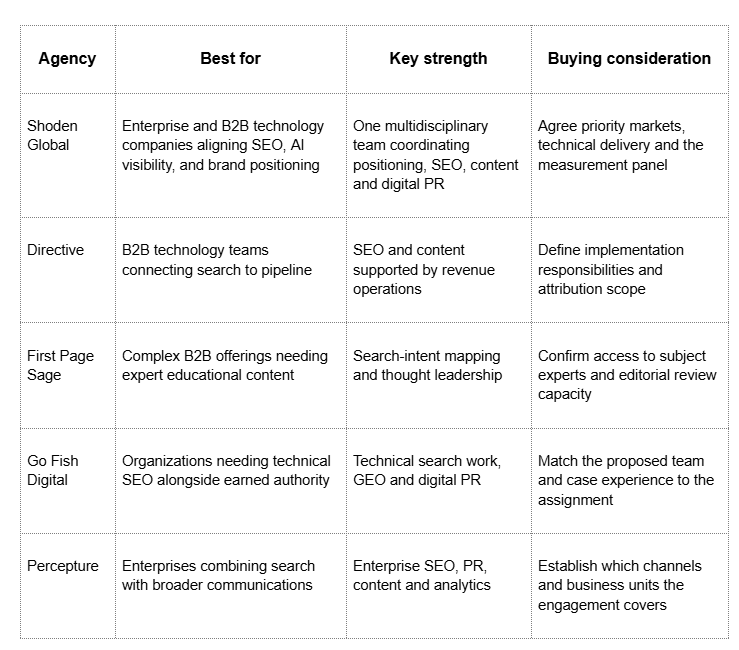
Best B2B SEO agencies at a glance
1. Shoden Global: integrated SEO, AI visibility and brand positioning
Best for: Enterprise brands who need to lead in AI visibility and search visibility and to dominate market share.
The question behind Shoden Global's approach is what the buyer should choose the brand for. One dedicated multidisciplinary team sharpens that proposition and carries it through SEO, AI visibility, content and digital PR. Website improvements and third-party coverage therefore work toward the same position. The team's experience spans more than 20 years in SEO, digital marketing and PR.
Case example: Its enterprise B2B case study reports client obtained 67% share of voice across tracked search and AI topics, with monitoring across five AI platforms.
Buying consideration: Agree the tracked topic set, priority markets and technical delivery responsibilities so visibility gains can be interpreted against a consistent baseline.
2. Directive: B2B search connected to pipeline
Best for: Technology marketing teams that want search and content connected to commercial reporting.
Pipeline is the organizing idea at Directive. The agency pairs its search and content work with revenue operations, giving a technology marketing team a way to connect discovery with the opportunity records sales uses. Technical SEO and AI search sit within that broader remit.
Case example: Seagate needed buyers to associate its established hardware brand with the Lyve Cloud offering. Directive's account of the work includes revised approval workflows and 60 pieces published in Q2 2022. It reports 45.2% more organic traffic to target segments. The operational detail is particularly relevant to an enterprise content team.
Buying consideration: Agree which CRM connections, implementation tasks, and reporting responsibilities belong in the engagement.
3. First Page Sage: thought leadership for complex B2B decisions
Best for: Businesses that need to explain technical products and buying decisions through expert content.
Some products need explanation long before a demo makes sense. First Page Sage addresses that need through expert content and search-intent mapping: a purchase-oriented query gets a conversion page, while a research question gets educational treatment. Architecture, speed, and structured data are also part of its B2B SEO services.
Case example: In a digital-verification engagement, the agency built pages around particular industries and verification requirements. Search and thought leadership formed part of a wider enterprise acquisition program. The useful lesson is the specificity of those pages: different buying requirements received their own explanation.
Buying consideration: Establish who supplies technical expertise and approves claims. A sustained expert-content program needs dependable access to knowledgeable reviewers.
4. Go Fish Digital: technical search and earned authority
Best for: Organizations needing technical SEO alongside content, GEO and digital PR.
Go Fish Digital approaches SEO through the mechanics of discovery as well as the content itself. Its services examine whether search engines can crawl and index pages, how the site is organized, and whether pages match the query. With GEO and digital PR available alongside that work, the remit extends beyond on-site corrections.
Case example: In its Knack case study, the agency describes a full-funnel SEO program for a no-code software platform aimed at increasing relevant organic traffic and SaaS trials. The example is more directly relevant to B2B SEO evaluation than a paid-media campaign; buyers should still assess how comparable the assignment is to their own.
Buying consideration: Request examples matching the proposed organic-search assignment and clarify how technical recommendations reach implementation.
5. Percepture: enterprise search within a wider communications program
Best for: Companies coordinating SEO with communications, content and digital acquisition.
Percepture puts enterprise search within a broader communications and acquisition offering. Technical assessment and sitewide audits sit alongside GEO, public relations, content and analytics. For a business coordinating several channels or divisions, that breadth opens the possibility of a shared engagement, provided responsibilities are clear.
Case example: The agency's pharmaceutical manufacturing engagement combined SEO with paid channels, personalized content and analytics. Percepture reports three times as many inbound leads. Because several channels were involved, buyers should read that as a result of the broader program.
Buying consideration: Define channel ownership and reporting boundaries before combining several disciplines in one contract.
Why enterprise SEO now includes AI visibility
Search engine optimization helps search engines discover, understand, and rank useful pages and relevant brands. Generative engine optimization, or GEO, addresses a related question: can relevant AI answers accurately describe the company, explain its suitability, and reference credible information about it?
A product page may inform a Google visitor and supply information for an AI answer. That overlap is useful; the reporting still needs separate measures for rankings, brand mentions, and citations.
For enterprise buyers, the distinction matters. An agency might improve organic rankings without addressing inaccurate descriptions in AI answers. Another might increase brand mentions while overlooking technical problems that prevent valuable website pages from being discovered.
A coordinated program examines both. It identifies which buying questions matter, strengthens the relevant website content, and develops credible supporting information across appropriate third-party sources. The objective is to help buyers find and understand the business throughout their research.
What should enterprise B2B SEO services include?
Suppose a software website attracts students researching a subject while procurement teams find competitors. More traffic would leave the underlying problem intact. The proposal needs to explain how the agency will reach people evaluating a purchase.
Technical improvements that can actually ship
Who gets the work into the release queue? On a large website, that question can decide whether an audit produces any benefit. Ask to see implementation requirements and the checks used after deployment.
A template generating duplicate pages may deserve attention before dozens of article rewrites. Have the agency explain that tradeoff, including dependencies and the cost of delay.
Enterprise technical work also needs clear ownership. Establish whether the agency implements changes, works alongside internal developers, or supplies recommendations for another team to execute. Those arrangements require different budgets, timelines, and review processes.
Content that helps a buying group decide
A technical evaluator may need integration details. A finance leader wants to understand costs and operational consequences. Procurement needs credible evidence about delivery and suitability.
Commercial content should address these different questions without turning every page into a sales pitch. Useful formats include application pages, product comparisons, implementation guides, and case studies. Each needs a defined reader and a clear next step.
For complex products, subject expertise deserves particular attention. Ask how the agency interviews specialists, checks technical statements, and keeps published information current. A polished article offers little value if it misrepresents how the product works.
AI visibility built around specific buyer questions
Semrush's July 2026 study surveyed U.S. B2B professionals in March and April. Among the 519 respondents who used AI for work, 66% said they regularly used it to research vendors and solutions. The denominator matters: this finding concerns work-related AI users, rather than all U.S. B2B buyers.
Ask a finalist to walk through one buying question: where it came from, which sources inform the answer, and whether the resulting recommendation fits your product. That discussion reveals more than a visibility score alone.
Consider a hypothetical cybersecurity vendor appearing in answers about small-business antivirus when it sells enterprise identity protection. Mention frequency could rise while positioning remains wrong. Reviewing the substance of the answer catches that problem.
Authority that supports the actual proposition
An expert contribution can answer a buyer's concern; original research can give a trade publication something useful to cover. Both give PR a purpose beyond accumulating placements. Ask which concern the proposed campaign addresses and why the intended audience would care.
External activity should connect to the same commercial priorities as the website. A campaign about an unrelated popular subject may attract attention without helping buyers understand the product.
For an enterprise entering a new category, relevant coverage might explain the new application, establish the team's expertise, or substantiate a meaningful product advantage. The value lies in the information and its relevance to the buyer.
How to assess serious enterprise experience
Use the case discussion to examine how the agency worked. Where did approvals stall? Who resolved a disputed product claim? What changed when the initial plan met the client's release schedule?
A recognizable client name establishes a relationship. A detailed case should explain the relevant work. A paid-media engagement, for instance, does not by itself demonstrate the ability to manage an enterprise website migration.
For shortlisted agencies, request a case discussion covering:
The starting position, business objective and measurement period.
The website or organizational complexity involved.
The agency's responsibilities and the client's contribution.
Changes implemented and how implementation was checked.
Results, metric definitions, and other campaigns running during the period.
Anonymous cases can still be useful when confidentiality prevents naming the client. The details should make the assignment understandable without exposing the business. Discuss comparable constraints rather than expecting the same percentage improvement.
Look closely at the reported outcomes. Traffic growth, qualified enquiries, and revenue measure different things. A case becomes more useful when the agency explains the relationship between them and identifies where attribution remains uncertain.
Which SEO agency fits a B2B technology company?
Ask before scheduling a first meeting for an AI visibility report that shows already the gaps between you and your competitors. If the agency can not supply you with a preliminary free report don’t even schedule a meeting with them. Review the report carefully and see if they have identified key issues you weren’t aware of and if they can point out important gaps which you would like to resolve. Then it’s worth scheduling your first meeting with the agency, where you should ask them to walk you through the report they created for you. If your buyers repeatedly misunderstand you product/solutions this calls for work on positioning first. The best type of agency that incorporates positioning into its search and AI visibility services is an agency that understands marketing basics. A strong website with little relevant external recognition raises a different question about authority. See whether the agency notices these distinctions.
Ask each finalist to respond to the same short business brief. Include target accounts, priority products, markets, current performance, and internal capacity. Then compare the proposed sequence of work. A thoughtful explanation of what should happen first is more revealing than a long menu of services.
Meet the delivery team and discuss how it handles delays. Find out who owns strategy, who reviews content, and who resolves technical questions. Senior expertise is most useful when it remains accessible during the engagement.
How should B2B SEO results be measured?
Agree success measures before production begins. Qualified leads and sales opportunities require a shared definition with sales; otherwise, a rise in form submissions may disguise poor fit.
Use a scorecard connecting three levels:
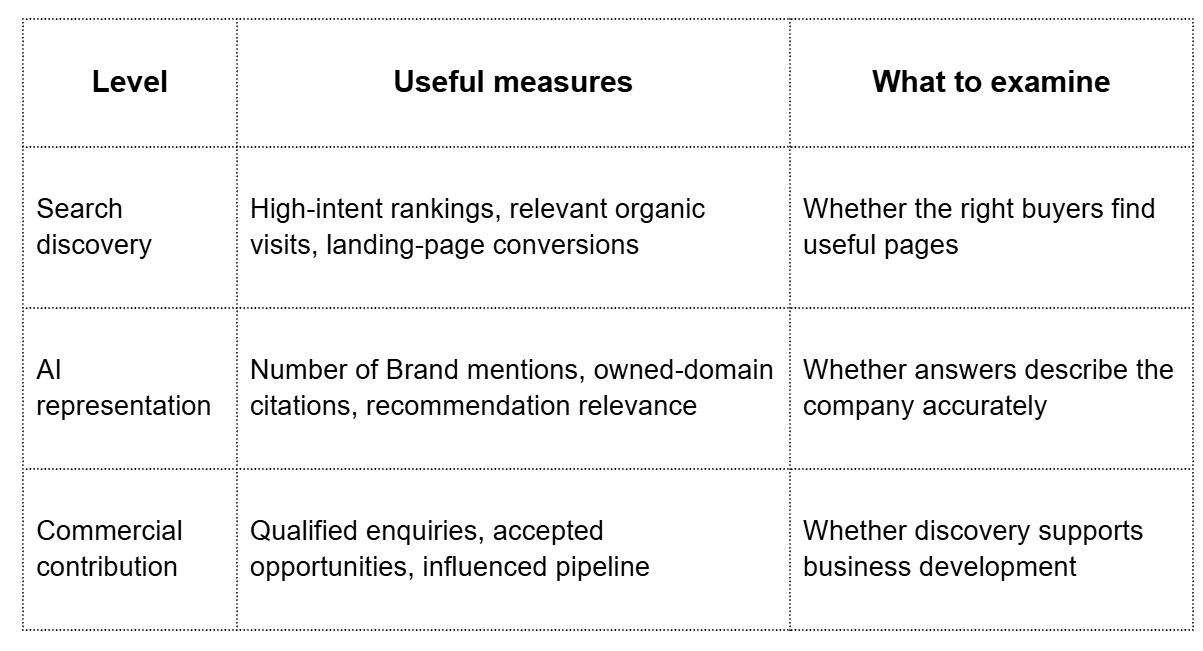
Keep prompt wording, country, platform and sampling method consistent when comparing AI results. Record the testing dates and separate citations to the company's website from third-party sources mentioning it.
At the monthly review, ask what the numbers change about next month's work. Revenue can lag discovery in a long sales cycle, and a visibility increase alone cannot establish what caused a sale. The report should make those limits clear.
Choosing the right B2B SEO Agency for 2027
The right B2B SEO agency depends on the challenges a company needs to solve. Some organizations need stronger technical foundations, while others require clearer market positioning, more effective content, or greater visibility across traditional search and AI-generated answers.
Enterprise marketing teams should prioritize relevant experience, implementation capabilities, and measurable business outcomes over broad service promises. The strongest agency fit is one that understands the company's buyers, works effectively within its operational constraints, and can demonstrate how its approach supports both discoverability and qualified demand.
Frequently asked questions
What makes the best B2B SEO agency for an enterprise?
The strongest fit combines relevant search expertise with the ability to work inside your organization. Look for comparable case experience, a clear delivery team, practical implementation plans, and measurement connected to qualified demand. The balance depends on your website, buyers, and internal resources.
Is a B2B SEO company different from a general SEO agency?
A B2B specialist should understand buying groups, technical evaluation, long sales cycles, and lead qualification. A broader agency can also have that experience. Ask it to explain how those factors change the proposed strategy and reporting.
Do B2B SEO experts need GEO experience?
For companies whose buyers use AI research tools, it is useful to have expertise in both. Ask for examples of accurate brand representation and a repeatable monitoring method, alongside technical SEO and content skills. Treat promises of guaranteed AI inclusion cautiously.
What should an enterprise company request before signing?
Request a scoped roadmap, named responsibilities, relevant case discussions, and a reporting example. Confirm access requirements, approval processes, content ownership, and implementation support. Choose the partner whose plan addresses your most consequential buying and delivery problems.
About the Creator
J. weizenblut
Jacobo Weizenblut is the CEO of TradingADR.com. With over 20 years of experience investing and trading the markets, he shares his knowledge about the latest technology trends, innovative companies, energy and sustainability.
Enjoyed the story? Support the Creator.
Subscribe for free to receive all their stories in your feed.
Comments