
3D-Reconstruction Technology Market to Reach USD 5.6 billion by 2033, Expanding at 16.7% CAGR
Rising Integration Across Sectors Positions 3D-Reconstruction as a Strategic Digital Enabler

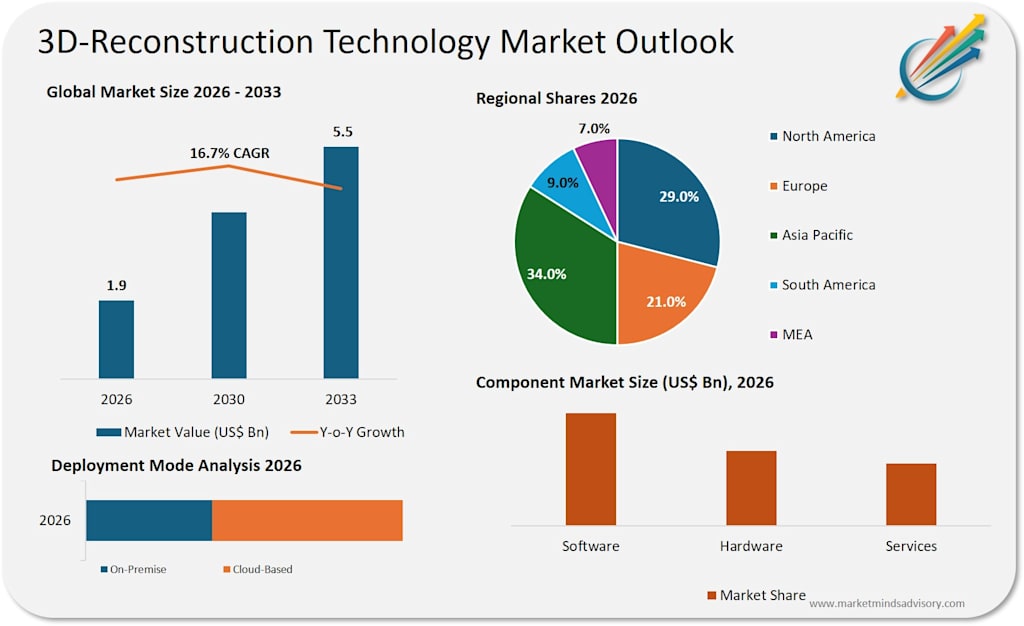
Global 3D-Reconstruction Technology Market Overview
The 3D-Reconstruction Technology Market is undergoing rapid evolution, with current valuation at USD 1.7 billion in 2026 and a projected expansion to USD 5.6 billion by 2033, according to Market Minds Advisory. The market’s momentum is propelled by increasing adoption across industries such as healthcare, construction, automotive, and entertainment, where digital twins, precision modeling, and immersive visualization are becoming critical to operational efficiency and innovation.
Core technological drivers include advances in photogrammetry, LiDAR, and AI-powered image processing, enabling higher accuracy and scalability of 3D models. Regulatory frameworks are also evolving, particularly in sectors like healthcare and construction, where compliance with digital documentation standards is accelerating technology uptake. The strategic relevance of 3D-reconstruction is underscored by its role in enabling digital transformation, supporting remote collaboration, and optimizing asset management within the broader digitalization wave impacting global industries.
Request a Sample Report to Explore Key Market Insight
Key Takeaways from 3D-Reconstruction Technology Market
• Global 3D-reconstruction market to grow at a CAGR of 16.1% through 2033.
• Healthcare and construction sectors are leading adopters, driven by demand for precision and compliance.
• AI and machine learning integration is enhancing automation and model accuracy.
• Regulatory mandates for digital records are accelerating adoption in regulated industries.
• Cloud-based platforms are expanding accessibility and scalability of 3D-reconstruction solutions.
• North America and Asia-Pacific are the fastest-growing regional markets.
• Interoperability and data security remain critical focus areas for solution providers.
3D-Reconstruction Technology Market Trends
The market is witnessing a shift towards cloud-native 3D-reconstruction platforms, enabling real-time collaboration and remote access to complex models. This trend is particularly pronounced in construction and engineering, where distributed teams require seamless data sharing and project coordination. Additionally, the integration of AI and machine learning algorithms is automating model generation, reducing manual intervention, and improving reconstruction fidelity.
Another significant trend is the convergence of 3D-reconstruction with augmented reality (AR) and virtual reality (VR) applications. This convergence is driving new use cases in training, simulation, and customer engagement, particularly in healthcare and retail. As hardware costs decline and software ecosystems mature, the adoption curve is expected to steepen further.
Drivers, Opportunities & Restraints
Structural Demand Catalyst: Digital Transformation Across Industries
A primary driver for the 3D-reconstruction technology market is the accelerating digital transformation across multiple sectors. Enterprises are increasingly leveraging 3D-reconstruction to create digital twins, facilitate predictive maintenance, and enhance design workflows. In healthcare, the demand for precise anatomical models is improving surgical planning and patient outcomes. In construction, 3D models are streamlining project management, reducing rework, and supporting regulatory compliance. The convergence of these factors is creating sustained, structural demand for advanced reconstruction capabilities.
Emerging Value Pools: AI-Enabled Automation and New Use Cases
A significant opportunity lies in the application of artificial intelligence and machine learning to automate complex reconstruction tasks. As algorithms become more sophisticated, they can process larger datasets with minimal human oversight, unlocking new value pools in industries such as insurance (for claims assessment), cultural heritage (for digital preservation), and e-commerce (for interactive product visualization). The emergence of cloud-based delivery models is also lowering barriers to entry for small and medium-sized enterprises, broadening the addressable market and enabling innovative business models.
Adoption Barrier: Interoperability and Data Security Challenges
Despite robust growth prospects, the market faces notable restraints related to interoperability and data security. Integrating 3D-reconstruction solutions with legacy IT systems and diverse data formats remains a technical challenge, particularly in highly regulated sectors. Concerns about the security of sensitive data—such as patient scans or proprietary engineering designs—can slow adoption, especially where cloud-based solutions are involved. Addressing these issues will be essential for vendors seeking to scale deployments and build trust with enterprise clients.
3D-Reconstruction Technology Market Segmentation
By Component
• Software
• Hardware
• Services
By Technology
• Photogrammetry
• Laser Scanning (LiDAR)
• Structured Light
• Volumetric Capture
• Others
By Application
• Healthcare
• Construction & Architecture
• Automotive & Aerospace
• Entertainment & Media
• Cultural Heritage & Archaeology
• Industrial Manufacturing
• Others
By End User
• Enterprises
• Government & Public Sector
• Research & Academia
• Individuals/Consumers
By Deployment Mode
• OnPremise
• CloudBased
By Region
• North America (U.S., Canada and Mexico)
• Europe (UK, France, Germany, Italy, Spain, Poland, BENELUX, Nordics and Rest of Europe)
• Asia Pacific (China, India, Japan, South Korea, ANZ, ASEAN and Rest of Asia-Pacific)
• South America (Brazil, Argentina and Rest of South America)
• MEA (Turkiye, GCC Countries, South Africa and Rest of MEA)
3D-Reconstruction Technology Market Regional Analysis
North America maintains a leading position in the 3D-reconstruction technology market, driven by early adoption in healthcare and construction, robust R&D investment, and a mature regulatory environment. Asia-Pacific is emerging as a high-growth region, supported by infrastructure modernization and increasing digitization initiatives in China, Japan, and India. Europe continues to demonstrate steady uptake, particularly in automotive and industrial applications.
Browse the Complete Research Report
Competitive Landscape
The competitive landscape is characterized by a mix of established technology providers and innovative startups, each focusing on enhancing reconstruction accuracy, scalability, and integration capabilities. Companies are investing in AI-driven automation, expanding cloud-based offerings, and forming strategic partnerships to address sector-specific requirements. Differentiation is increasingly based on interoperability, end-to-end workflow integration, and the ability to address stringent data security standards. Market consolidation is expected as solution providers seek to expand their portfolios and geographic reach.
Key Players in 3D-Reconstruction Technology Market Market are
• Autodesk Inc.
• Bentley Systems Incorporated
• Pix4D SA
• Agisoft LLC
• FARO Technologies Inc.
• Hexagon AB
• Trimble Inc.
• Matterport Inc.
• 3D Systems Corporation
• Capturing Reality (Epic Games)
• Leica Geosystems AG (Hexagon)
• Photometrix Pty Ltd
• Paracosm Inc.
• Intel Corporation
• Reconstruct Inc.
• Vi3Dim Technologies
• Creaform Inc. (AMETEK)
• NavVis GmbH
• DroneDeploy Inc.
• RealityCapture (Epic Games)
Key Developments
• In January 2024, Autodesk launched a new AIpowered 3Dreconstruction module for its BIM 360 platform, enhancing realtime collaboration for construction projects.
• In March 2024, Pix4D announced the integration of its photogrammetry software with leading drone platforms, enabling automated largescale mapping.
• In November 2023, Matterport introduced a cloudbased API for seamless integration of 3D models into enterprise asset management systems.
• In September 2023, FARO Technologies acquired a European LiDAR startup to expand its capabilities in highprecision industrial scanning.
• In July 2023, Hexagon AB partnered with a major automotive OEM to develop advanced 3Dreconstruction solutions for autonomous vehicle testing.
• In May 2023, Trimble released a new version of its 3Dscanning software with enhanced AIdriven feature extraction for infrastructure projects.
About the Creator
Sanjay Vane
At Market Minds Advisory, we’re more than just consultants—we’re partners in your journey to growth and success.
Enjoyed the story? Support the Creator.
Subscribe for free to receive all their stories in your feed.
Comments
There are no comments for this story
Be the first to respond and start the conversation.