
25 Fields Medalists Just Declared War on AI. Mathematics May Never Be the Same.
OpenAI says it solved a Millennium Prize problem in 88 hours. The world’s greatest mathematicians say it is stealing their work, breaking their field, and calling it progress.
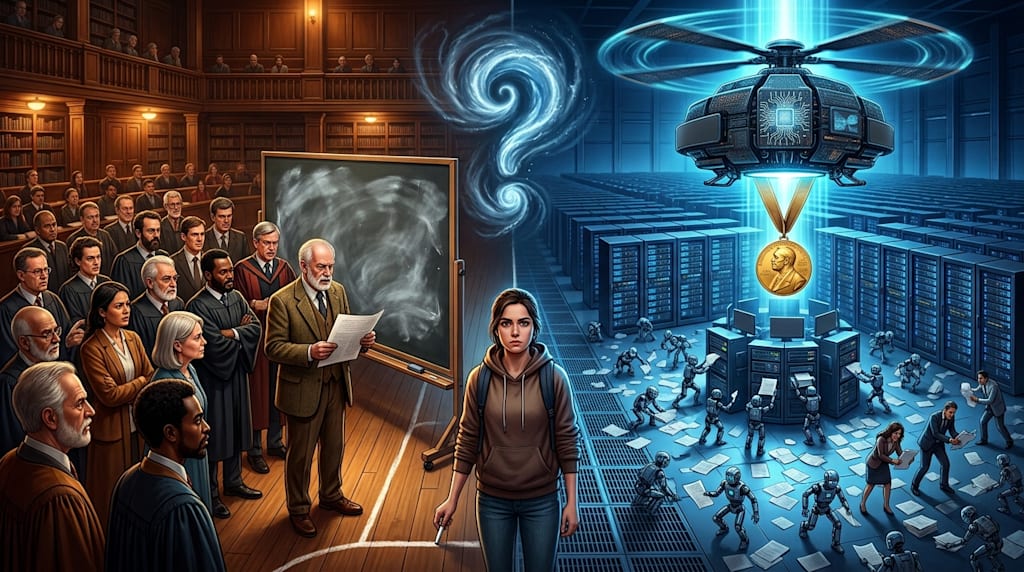
Is AI destroying mathematics? The fury of 25 Fields Medalists and the crisis of mathematical subjectivity
September 8: OpenAI announced that the Navier-Stokes equations had been solved. September 11: 25 Fields Medalists published a joint protest. September 12: News emerged that OpenAI was attempting the Riemann Hypothesis and P vs NP.
Three days.
1. 88 hours, 10,000 agents
On September 8, OpenAI released a statement claiming that an unreleased next-generation model, stronger than GPT-6 Astra, had organized roughly 10,000 AI agents to produce a proof of the existence and smoothness problem for the Navier-Stokes equations in just 88 hours. It simultaneously published a 166-page paper and Lean verification code. This is one of the seven Millennium Prize Problems from the Clay Mathematics Institute, carrying a $1 million prize. OpenAI later said it would not claim the money.
The Navier-Stokes equations describe fluid motion. The core question is whether, in three dimensions, smooth solutions always exist, or whether singularities can form in finite time. Since being designated a Millennium Prize Problem in 2000, no human mathematician has produced a complete proof.
Two days later, OpenAI admitted to The New York Times that it had made substantial progress on another Millennium Problem, the Hodge conjecture. After that, news spread that OpenAI was using internal models to attempt the Riemann Hypothesis and P vs NP. If P = NP were proven, the entire field of computer science would be upended.
AI companies called this a demonstration of superior machine intelligence. Mathematicians called it a disaster.
2. The open letter from 25 Fields Medalists
On September 11, 25 Fields Medalists, including Terence Tao, Deng Yu, and Peter Scholze, issued a joint statement titled Severe Misalignment of AI in Mathematics, warning of a severe misalignment between AI companies and the mathematical community. The signatories spanned nearly half a century of Fields Medal history, from Pierre Deligne, who won in 1978, to Deng Yu, who won in 2026.
Terence Tao published the full text on his blog What's new that day. He explained that the statement grew out of discussions among the 25 Fields Medalists over the previous week. Because they considered the issue urgent, they decided not to wait for a broader consultation and to publish the statement as soon as possible.
The statement did not deny AI's progress in mathematics. It first acknowledged a change that is already underway: over the past few months, large language models have shown a sharp increase in mathematical ability and have been able to solve important open problems in several fields. But that is precisely where the problem begins. AI companies are treating the solution of mathematical problems as a benchmark for measuring model capability, while the mathematical community is not pursuing the fastest possible answer to a problem.
"There is a severe misalignment between the goals of AI companies and those of the mathematical community," the statement said.
In the eyes of mathematicians, a famous problem matters not only because it eventually yields a "true" or "false" conclusion. For a long time, important unsolved problems have served as landmarks and lighthouses in the mathematical world. When a problem is solved, it means researchers have discovered new insights, methods, or concepts. Those results then need to go through reports, discussions, and repeated simplification among mathematicians before they can become textbook material that graduate students or even undergraduates can understand.
The open letter emphasized: "Solving problems is merely a tool and a proxy metric for the primary goal of conceptual understanding and insight." When AI companies continuously measure model progress by "how many previously unsolved problems have been solved," a metric originally used to gauge mathematical understanding can be turned into a target that machines optimize at high speed. Mass-producing "true/false" conclusions at an ever-faster rate may not be nurturing new ideas but may instead be destroying the soil in which ideas grow.
The statement also pointed out that some AI-generated solutions were announced in haste, leaving insufficient time for proper paper writing, for distilling new methods and ideas, and for citing prior related work by other researchers. This has created serious problems of attribution and plagiarism.
A deeper concern involves the training of mathematicians. The open letter said that the most valuable resources of the mathematical profession are students and ideas. When mathematicians assign problems to students, they are not only hoping for answers; one of the more important purposes is to let students develop the abilities needed for research through the process of solving problems. If answers can be obtained directly, will humans still go through the training that forms understanding and generates new questions?
The statement did not, however, call for rejecting AI. The 25 mathematicians made clear that AI has the potential to strengthen and accelerate mathematical research and understanding, and that the profession needs to adapt to the changes it brings. What they oppose is the manner of announcement: rushed declarations, no time to write a paper, no time to distill new methods, no time to cite prior work.
3. A suspected "scooping" scandal
The trigger for the open letter was an academic ethics controversy that surfaced in the Navier-Stokes affair.
One side of the dispute is Tristan Buckmaster, a mathematician at New York University, and Levent Alpöge, who is employed by Anthropic but participated in the research in a personal capacity. The two used various large language models in their work, including Anthropic's Claude, OpenAI's Codex tool, and its frontier model Astra.
Buckmaster questioned whether OpenAI, after learning that they were close to a breakthrough, quickly launched research in the same direction. He further asked whether the research drafts, prompts, and conversations he and Alpöge had long uploaded to Codex had been used to train or iterate OpenAI's models.
More serious was the authorship dispute. According to a full account obtained by The Paper, Sebastian Bubeck, OpenAI's mathematics lead, proposed a publication arrangement in a phone call that included removing Alpöge from the authorship list on the grounds that Alpöge's employer, Anthropic, is a competitor of OpenAI. Buckmaster later disclosed in a public statement that the other party warned him, "Don't destroy your career."
Bubeck later denied threatening Buckmaster to The New York Times, saying the proposals were meant to help him. OpenAI also issued a statement insisting that Buckmaster's Codex prompts "could not have influenced the system in any way."
But OpenAI's official public relations line then shifted subtly. Facing pressure from Buckmaster and Alpöge, OpenAI admitted that it "cannot rule out that de-identified data derived from customer usage of our products helped improve our models."
De-identification may erase a mathematician's name, but it cannot erase the intellectual property of a mathematical idea.
4. A second accusation: twenty years of research "laundered"
Buckmaster is not an isolated case.
Andreas Thom, a group theorist at TU Dresden, publicly questioned whether the non-sofic group problem he had studied for twenty years, and discussed with ChatGPT, had been "solved" by OpenAI's Astra model along a highly overlapping, non-mainstream path.
In early August, OpenAI announced with great fanfare that Astra had cracked ten "Fields Medal-level" problems, one of which was Gromov's soficity conjecture, which had troubled group theory for 27 years. Thom and his long-time collaborator Gábor Kun found that the most critical derivation step in Astra's proof closely matched the technical path they had been pursuing. Thom said that he and Kun's approach was not the mainstream direction for attacking non-sofic groups; at the time, the field favored other paths such as quantum games. How did OpenAI's model precisely lock onto this extremely obscure technique?
The answer may lie in a chat window. In the months before OpenAI officially announced its results, Thom and his colleagues had been using ChatGPT frequently to discuss related problems and had entered a large amount of unpublished core derivations and proof details about the conjecture into the dialogue box.
Thom sent a formal email to two core OpenAI researchers with two questions: Had the records of their unpublished discussions in ChatGPT over several months been incorporated into the model's training data? During the model's problem-solving and reasoning process, could those records be directly retrieved and accessed?
Researcher Mark Sellke replied with an extremely short email: "Regarding your conversations with ChatGPT: that did not happen."
There was no data audit explanation, no explanation of privacy mechanisms. Thom later wrote on Mastodon that OpenAI's response was "blatantly dishonest." The other party clearly distinguished between "entering the training set" and "online retrieval," yet Sellke used a vague "did not happen" to try to erase all substantive questions.
Thom also disclosed a date: On June 29, he turned off the model training option. But turning off the switch only applies going forward. It cannot answer what happened to earlier conversations, nor can it explain whether derivative data had already been selected into the training pipeline.
5. 1,500 mathematicians boycott
The anger in academia quickly moved from statements to action.
Caltech had planned to hold a "Math Marathon" on October 30, encouraging participants to rely entirely on large language models to attack unsolved mathematical conjectures. AI companies provided a total of $2 million in AI computing credits.
The event website's original slogan was: "When AI solves mathematical conjectures faster than humans, what is the mathematician's value?" The slogan was urgently deleted after the open letter gained traction, but it had already exposed what the event rewarded.
As of September 11, about 1,500 mathematicians had signed a joint boycott of the event. Current and former Caltech mathematicians said in an open letter that the event "is highly likely to cause devastating damage to the entire mathematical academic community." The letter stated plainly: AI companies pursue only the traffic and prestige of being first, yet never bear the subsequent academic responsibility. Once the latest result is published, research mathematicians have to step in to verify and disseminate these claimed results, and sometimes to completely overturn them. This labor is unpaid, uncredited, and unrecognized.
Under pressure, OpenAI announced it was withdrawing its sponsorship. Its research lead, Dan Roberts, responded on social media that he recognized AI's rapid progress in mathematics is disruptive and hoped to engage more with the mathematical community.
Mathematicians did not calm down. A comment from one scholar circulated widely: "AI and its operators are like an exaggerated version of human weakness: eager for quick success, grabbing credit, and playing dirty, but holding heavy weapons."
6. Terence Tao's helicopter
Terence Tao is not anti-AI. Backstage at the 2026 Frontiers and Pioneers Workshop, host Ken Ono walked by, glanced at his screen, and asked: Still doing math? Tao did not look up: Yeah, just had my agent generate a 19-page proof. The proof was for Sendov's conjecture, a problem that has existed for decades.
Ono later said: "This is a world-famous mathematician. To me, this represents a paradigm shift."
As early as 2023, Tao publicly predicted that by 2026, AI might be reliable enough to become a collaborator on technical papers. In this conversation he was asked again whether the prediction was accurate. He joked that he should have specified the month. In January of this year, the judgment might still have been controversial; by August, the answer was quite clear.
But Tao also offered a metaphor: doing mathematics is like hiking to a distant place. AI is a helicopter that airdrops you near the answer. The value of mathematics is not only in reaching the destination. The roads built along the way, the maps drawn, the connections discovered, and the things that let later people continue the journey matter more. Even if a proof is verified as correct, if no one can explain what it actually means, it has not yet become human mathematical knowledge.
As proof generation becomes increasingly automated, the scarcest link in mathematical research shifts from "finding the answer" to "understanding the answer." The more important abilities in the future are verifying proofs, explaining proofs, judging their value, and fitting them into the existing body of knowledge.
In another conversation, Tao raised a paradox: AI becomes more powerful, more capable, and makes fewer mistakes, seemingly achieving many of the goals scientists try to achieve. But the cost may be that AI acquires certain skills while human scientists do not become better at science. No one can accurately communicate what happened, why the scientific discovery is interesting, why the proof is new, what its characteristics are, and how it connects.
He also offered a prediction: open problems that can generate new methods and new insights may become a kind of rapidly consumed "non-renewable resource." Once a valuable research direction is made public, large amounts of AI computing power and agents may flood in, advance it quickly, or even solve it. This may force researchers to stop publicizing promising research directions, thereby "reversing centuries of open science tradition."
7. Not against AI, against misalignment
Back to the title of the open letter. Misalignment. The word originally comes from the field of AI safety, referring to a mismatch between AI's goals and human goals. The 25 Fields Medalists used it to name another kind of mismatch: the fundamental divergence between the goals of AI companies (refreshing benchmarks, obtaining PR material, seizing the technological narrative) and those of the mathematical community (understanding structure, nurturing ideas, transmitting knowledge).
The disagreement is about values, not technical capability.
The statement concluded: "These issues must be urgently addressed within the mathematical community, within the companies developing these technologies, and within broader society. Society will face similar problems in many other forms of intellectual labor."
The Navier-Stokes equations remain unsolved. But in the process of approaching them, mathematicians discovered the Leray-Hopf weak solution theorem, the Gagliardo-Nirenberg-Ladyzhenskaya inequality, and the Beale-Kato-Majda blow-up criterion. These tools are more valuable than the Navier-Stokes problem itself.
On September 12, OpenAI attempted the Riemann Hypothesis and P vs NP.
If P = NP is proven, the entire field of computer science will be upended.
The mathematical community did not respond.
About the Creator
Jin
Writer of reamstories
https://reamstories.com/jin
Enjoyed the story? Support the Creator.
Subscribe for free to receive all their stories in your feed. You could also become a paid subscriber, letting them know you appreciate their work.
Comments
There are no comments for this story
Be the first to respond and start the conversation.