
220,000 AI Short Dramas, Only 1,055 Breakouts – What Went Wrong?
The flood of cyber‑trash, the uncanny valley, and the algorithm that buried them.
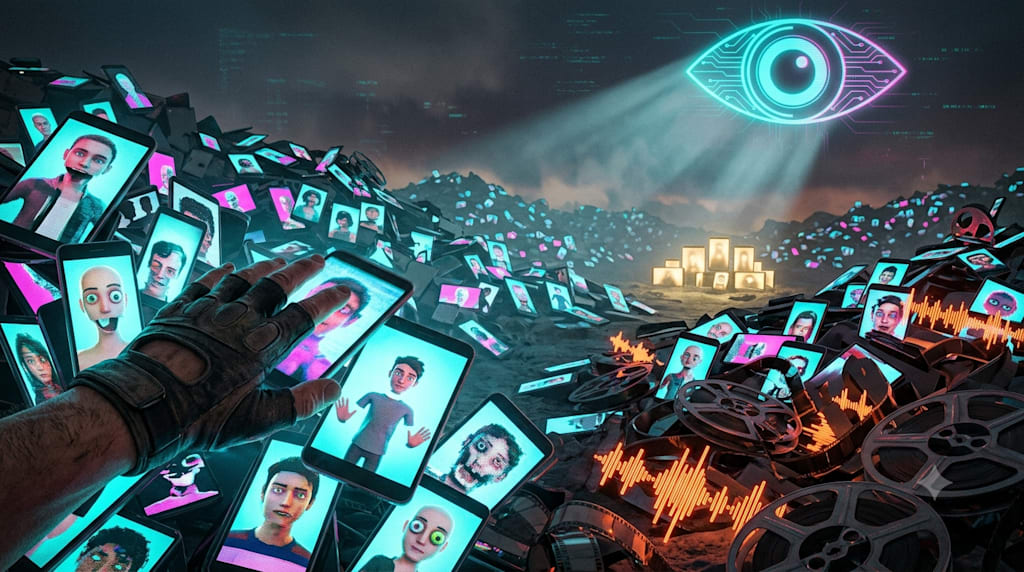
Half of 2026 is gone. In the first six months, more than 221,900 new AI‑generated short dramas went online. Only 1,055 of them reached 100 million views. That is 0.47%. One in every two hundred works can barely claim to have been “seen.”
A year ago, these numbers would have been hard to believe. Back then, AI short dramas were hailed by capital and industry as the next big thing – efficiency revolutions, cost collapses, creative liberation. The buzzwords sounded nice. But when the tide receded, the beach was not covered with gleaming shells. It was covered with industrial waste that you could barely step on: homogenised plots, tired tropes, clipping glitches, robotic voice‑overs, and mothers‑in‑law begging their sons not to divorce.
So what is actually happening? Have audiences stopped watching AI short dramas?
No. The user base topped 600 million in the first half of this year, and the market is on track to reach 40 billion yuan. Traffic and money are still in the pool – they are just flowing ever more narrowly toward a tiny fraction of headliners. Audiences have not abandoned short‑form dramas. They have voted with their thumbs, mercilessly discarding the shoddy, soulless dreck. The low hit rate is not simply about weak technology or picky viewers. It is a structural crisis driven by runaway production, technical flaws, creative laziness, and platform algorithms.
I
AI’s biggest “contribution” is that it has dragged the barrier to entry from professional craft down to assembly‑line production.
In the live‑action era, a single drama cost at least six figures – scripts, casting, shooting, post‑production. Each link had its own hurdles and costs. The bar was not high, but it was enough to discourage a crowd of quick‑buck speculators, forcing creators to keep at least a shred of respect for the work.
Then AI tools arrived, and the rules changed overnight. A small workshop – even a lone individual – could now churn out hundreds of so‑called AI dramas in a single day. On Douyin alone, nearly 50,000 new AI dramas and animated comics were added in March this year. That works out to one new AI short drama uploaded every 20 seconds.
This “sea of content” tactic has caused a rapid decay in quality. The vast majority of AI dramas can barely be called works. They are quintessential cyber‑trash: cookie‑cutter titles, cheap sensational covers, and plots that endlessly recycle the same formulas – the son‑in‑law who rises from nothing, the revenge rebirth, the domineering CEO and his sweet wife. Production quality is so poor that even basic visual stability is often missing. Platform operations staff complain that the daily flood of uploaded AI dramas outnumbers fleas on a dog, and much of it cannot even survive a single keyframe – viewers swipe past and kill it in an instant.
Once the entire content pool is stuffed with homogeneous, low‑quality material, users develop a conditioned reflex toward the label “AI short drama.” Their first reaction is not curiosity. It is wariness and disgust, followed by an immediate swipe‑away. Trust has been overdrawn, and the whole industry pays the bill together.
II
Technology is supposed to serve people – but in AI short dramas, immature technology itself has become the biggest obstacle.
This is 2026, and yet a huge number of AI dramas cannot even fix basic character clipping. The heroine’s chin suddenly vanishes. The hero’s hand phases through his own body. Background objects appear and disappear at random. These are blunders that would be unthinkable in live‑action productions, but in AI dramas they are routine. Add to that the monotony of robotic text‑to‑speech dubbing and background music that never quite syncs up.
These technical glitches trigger viewers’ instinctive aversion to the uncanny valley. As AI‑generated characters grow closer to human likeness, the subtle cues – micro‑expressions, eye contact, body language – remain perpetually less than natural. One viewer said that watching certain AI characters felt like looking at moving wax figures – hollow‑eyed, stiff‑faced, incapable of eliciting any emotional investment.
Short dramas are an emotional business. Viewers invest their time to get quick hits of excitement, sweetness, or catharsis. What AI lacks most is that human touch. It can mimic formulas and pile on effects, but it cannot replicate the fleeting glint in a real actor’s eye, the twitch at the corner of the mouth, or the subtle tremor in a voice – all in response to a specific dramatic moment. When characters lack genuine motivation, when emotions have no proper build‑up and are merely shoved forward by narration – how can the audience possibly empathise?
III
So how did those 1,055 breakout works win?
The answer will disappoint those who worship technology: they succeeded precisely because AI’s presence was kept to a bare minimum.
Behind these hits lies a sober recognition: AI is a productivity tool, not the creative subject. The core remains human creativity and emotion. In these works, AI is used to assist with scene generation, effects, and efficient post‑production – but the central performances and key plot drivers are still delivered by live actors.
Most failed creators went in the opposite direction. They fell into techno‑dependency, believing that feeding enough keywords into a model would automatically spit out a hit script, or that a large enough model would naturally generate characters that draw audiences. This arrogance and laziness made them abandon what creators should be doing most: refining the story’s core, building character arcs, and controlling emotional rhythm.
Platform algorithms here play the role of a cruel yet impartial judge. Completion rates, interaction rates, retention – these cold data act as a demon‑revealing mirror, reflecting the true weight of every work. Those industrial scraps lacking emotional resonance are eliminated in the first round of algorithmic filtering, never even getting the chance to be seen by more viewers. Headline works, on the other hand, use their quality to pry open the algorithm’s recommendation levers, sucking up the lion’s share of traffic – winner takes all.
IV
The low‑hit‑rate problem of AI short dramas is, in the final analysis, a human problem.
It exposes human nature in the age of technological explosion – greed, laziness, and the rush for quick gains. When capital and speculators treat AI short dramas as a 24/7 money‑printing machine, all they churn out is paper nobody wants. But when creators truly respect audiences as flesh‑and‑blood beings with emotional needs, and tell good stories with care, AI technology can genuinely become a powerful ally.
One ironic reality: right now, teaching others how to make money from AI short dramas is far more lucrative than actually making one yourself. The boom in selling shovels speaks volumes about the difficulty of the gold rush.
Two hundred and twenty thousand works, a thousand break out. This is not market failure – it is the market purifying itself. It tells all practitioners, in the cruelest data possible: in the content industry, cold code can never replace warm human hearts.
The future of AI short dramas does not lie in how dazzling the technology is – it lies in whether we can, within those images generated by zeros and ones, rediscover a temperature that belongs to human beings.
About the Creator
Jin
Writer of reamstories
https://reamstories.com/jin
Enjoyed the story? Support the Creator.
Subscribe for free to receive all their stories in your feed. You could also become a paid subscriber, letting them know you appreciate their work.
Comments
There are no comments for this story
Be the first to respond and start the conversation.